


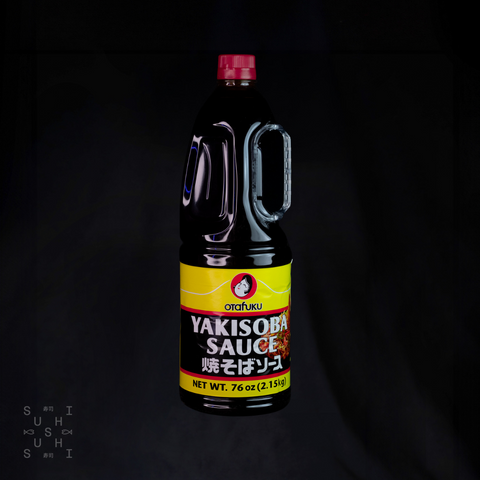
Otafuku, Yakisoba Sauce, 1.8L
The sauce behind Japan's favourite festival noodles, in catering format.
Yakisoba sauce is the sweet and savoury Japanese stir-fry sauce that coats yakisoba noodles, a staple of street stalls and festivals across Japan. Otafuku's version is built on fruit and vegetable flavours, giving it a thicker, more rounded finish than a simple soy-based stir-fry sauce. The 1.8L handled bottle, 2.15kg net, is made for professional kitchens and street-food operations running yakisoba at volume.
Why Chefs Choose This
- The Japanese standard: Otafuku is one of Japan's biggest sauce makers, and this is the flavour yakisoba is known for.
- Ready to use: no mixing or dilution; pour straight onto noodles in the wok or on the griddle.
- Catering volume: a 1.8L handled bottle for heavy kitchen use and fewer bottle changes.
- Reliable caramelisation: gives good colour and glaze at high heat.
How to Use
- Classic yakisoba: stir-fry noodles with vegetables and protein, then add sauce in the final minute and toss to coat.
- Yakisoba pan: fill a hot-dog roll with sauced yakisoba noodles, Japan's favourite carb-on-carb snack.
- Teppanyaki glaze: a finishing sauce for griddle-cooked meat and vegetables.
- Stir-fry shortcut: an all-in-one sauce for any noodle stir-fry, not just yakisoba.
Yakisoba (焼きそば) means fried noodles. Despite the name, it is not made with buckwheat soba but with wheat chūka men, the same family of noodles as ramen, stir-fried on a teppan with cabbage, pork and sauce. It is a fixture of Japanese festival stalls and beach huts, and turns up in a bread roll as yakisoba pan. The sauce sits in the same family as Japan's Worcestershire-style sauces, sweet, tangy and fruit-forward, but it is thinner and less sweet than okonomiyaki sauce, so it coats each strand without pooling. Otafuku traces its roots to a Hiroshima shop opened in 1922.
Learn more: Japanese Sauces
What does yakisoba sauce taste like?
Sweet, tangy and savoury in roughly equal measure: somewhere between British brown sauce and a sweet soy glaze, with more depth than either. Fruit and vegetable sweetness comes first, then a vinegar lift and a gentle spice at the back. It is runnier than okonomi sauce, so it spreads evenly through noodles, and in a hot wok it caramelises quickly, turning glossy and slightly smoky. That caramelised edge is the flavour of festival yakisoba.
Pairs with: Otafuku Okonomi Sauce, Toa Dried Ramen Noodles (720g) and Kewpie Mayonnaise.
Product Details
| Type | Yakisoba sōsu 焼そばソース (yakisoba sauce) |
| Brand | Otafuku (オタフク) |
| Origin | Japan |
| Net Weight and Format | 1.8L handled plastic bottle, 2.15kg net |
| Storage | Ambient; refrigerate after opening |
| Best Used As | Yakisoba, stir-fried noodles and teppan glazes |
What is the difference between yakisoba sauce and okonomiyaki sauce?
Both are fruit and vegetable based Japanese brown sauces, but they are designed for different dishes. Okonomiyaki sauce is thicker and sweeter, made to sit on top of a pancake without running off. Yakisoba sauce is thinner, slightly sharper and designed to coat noodles evenly during stir-frying. Otafuku makes both, and while you could substitute one for the other in a pinch, the thickness and sweetness will be noticeably different. For the right result, use the sauce designed for the dish.
How much yakisoba sauce do you need per portion?
As a rough guide, 30 to 40ml of sauce per single portion of yakisoba (about 150g of cooked noodles) gives a well-coated result without the dish turning soggy. A 1.8L bottle therefore covers roughly 45 to 60 portions. Adjust to taste and heat level; the sauce caramelises as it cooks, so adding it to a very hot pan concentrates the flavour and reduces the volume slightly.
Can you use yakisoba sauce for dishes other than yakisoba?
Yes. It works as a general-purpose stir-fry sauce for any noodle dish where you want a sweet and savoury Japanese glaze. It is also used as a teppanyaki finishing sauce, a glaze for grilled meats, and a base for Japanese-style fried rice. Some street-food traders use it on hot dogs and burgers as a Japanese alternative to brown sauce. Anywhere you want caramelisation, sweetness and umami without building a sauce from scratch, it does the job.
SKU : X0016