
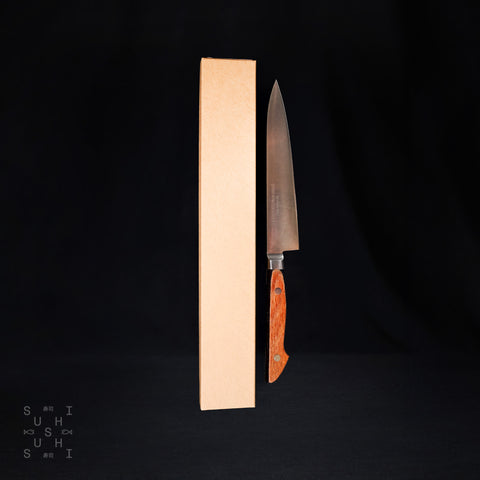
Sakai Takayuki TUS Petty Knife 150mm
A 150mm stainless petty knife from Sakai for the small, fiddly jobs a chef's knife is too big for.
The Sakai Takayuki TUS Petty is a Japanese utility knife with a 150mm blade, around 29mm deep at the heel, in Takayuki's own TUS stainless steel. It is double-bevelled, so it works for right- and left-handed cooks, and fitted with a Western-style pakkawood handle. Peeling, trimming, segmenting citrus, deveining prawns, cutting garnish: this is the knife that does the close work while the gyuto stays on the board.
Why Chefs Choose This
- Right size for detail: 150mm is long enough to slice a shallot and short enough to turn a mushroom.
- Low-maintenance steel: TUS is a molybdenum-vanadium stainless steel, so it shrugs off acidic fruit and a wet board.
- Easy to sharpen: at around 58 to 59 HRC it takes an edge quickly on a whetstone and is less prone to chipping than harder steels.
- Familiar grip: a Western-style pakkawood handle that feels at home to cooks used to European knives.
How to Use
- Fruit and veg prep: peeling, coring, hulling and segmenting citrus and apples.
- Fine work: garnishes, shallot brunoise, trimming herbs and turning vegetables.
- Small protein jobs: deveining prawns, trimming silverskin and portioning small fish fillets.
- Care: hand wash and dry straight away, store on a magnet or in a guard, and hone it little and often.
Sakai (堺), in Osaka Prefecture, has been a centre of Japanese blade-making for centuries, and the city's craftsmen are known for splitting the work between specialist forgers, sharpeners and handle makers. Sakai Takayuki (堺孝行) is the knife brand of Aoki Hamono (青木刃物製作所), one of the best-known makers in the city. The petty (ペティナイフ) takes its name from the French petit: it is Japan's version of the small utility or paring knife, and every Japanese kitchen has one alongside the gyuto.
Learn more: Sakai Takayuki: The Home of Japanese Knives
What is a petty knife used for?
Anything too small or delicate for a chef's knife. A petty handles the jobs you would otherwise do in your hand or with a paring knife: peeling and segmenting fruit, trimming vegetables, cutting garnishes, scoring, and small butchery such as trimming a tenderloin or cleaning prawns. At 150mm it is a little longer than a Western paring knife, so it can also slice small items on the board, which is why many chefs use it as their second knife.
Product Details
| Type | Petty knife (ペティナイフ), Japanese utility knife |
| Brand | Sakai Takayuki (堺孝行), made by Aoki Hamono |
| Blade Length | 150mm |
| Blade Height | Approx. 29mm at the heel |
| Steel | TUS stainless steel (molybdenum-vanadium), approx. 58 to 59 HRC |
| Edge | Double bevel, suits left- and right-handed users |
| Handle | Western-style black pakkawood |
| Inscription | TAKAYUKI TUS STEEL |
| Origin | Sakai, Osaka, Japan |
Is TUS steel stainless?
Yes. TUS is Sakai Takayuki's own molybdenum-vanadium stainless steel. It resists rust far better than carbon steel, which makes it a good first Japanese knife or a hard-working knife for a busy kitchen. Wash and dry it after use all the same; no knife likes being left wet.
Can it go in the dishwasher?
No. Heat, detergent and knocks from other items will dull the edge and damage the pakkawood handle. Hand wash in warm soapy water, dry it straight away, and store it on a magnetic strip, in a block or in a blade guard.
How do I sharpen it?
On a whetstone. A medium grit (around 1000) sets the edge and a finer stone (3000 to 6000) polishes it. Because the blade is double-bevelled, sharpen both sides evenly. Between sharpenings, a few strokes on a ceramic honing rod keeps it keen. Our Masterclass has a step-by-step guide for Sakai Takayuki knives.
SKU : T3028