
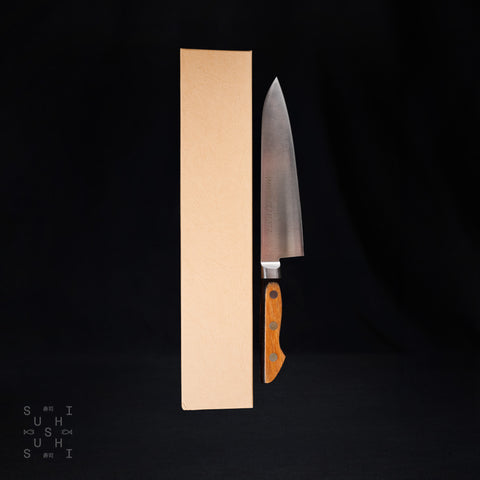


Sakai Takayuki TUS Chefs Knife 180mm
A 180mm Sakai Takayuki gyuto in TUS high-carbon stainless steel: an easy-care, properly sharp Japanese chef's knife for a first blade or a busy line.
This is the TUS gyuto from Sakai Takayuki, the knife brand of Aoki Hamono in Sakai, the city at the centre of Japanese professional knife making. The blade is a single high-carbon stainless steel stamped TAKAYUKI TUS steel, double-edged, with a steel bolster and a Western-style handle of plywood held by three rivets. Aoki describe the TUS as a slightly lightweight knife, and it is made for both home and professional kitchens. At 180mm it is quick and easy to control.
Why Chefs Choose This
- Stainless and forgiving: high-carbon stainless steel resists rust, so it copes with a wet, busy kitchen
- Sharp from the box: ground thinner than most Western chef's knives, for clean, precise cuts
- Familiar handle: a riveted Western-style handle with a bolster, comfortable if you are moving from a European knife
- Sakai made: from Aoki Hamono, one of the best-known knife houses in Sakai
How to Use
- Everyday prep: slicing, dicing and chopping vegetables, herbs, boneless meat and fish
- Push and pull cuts: let the edge do the work with a forward or drawing stroke rather than heavy force
- Avoid hard work: no bones, frozen food or hard shells, which can chip a thin edge
- Right board: cut on wood or a soft cutting board, never glass, stone or steel
The gyuto (牛刀, literally beef knife) is Japan's version of the Western chef's knife, adopted in the Meiji era as Western cooking arrived and now the everyday knife in most Japanese professional kitchens. Sakai, in Osaka Prefecture, has made blades for centuries and is still home to the specialist forgers, sharpeners and handle makers who produce most of Japan's professional kitchen knives. Aoki Hamono sells its knives under the Sakai Takayuki (堺孝行) name, and the TUS range is its dependable stainless line: less showy than its Damascus and carbon steel knives, and much easier to live with.
Learn more: Sakai Takayuki: The Home of Japanese Knives
Is 180mm the right size for a gyuto?
For most home cooks, and for anyone working on a small board or in a tight section, yes. A 180mm gyuto is nimble, light in the hand and easy to control for fine work such as shallots, herbs and garlic, while still long enough to slice a chicken breast or a salmon fillet in a single stroke. Many professionals prefer 210mm or 240mm for speed on big prep, but a 180mm is the knife people tend to reach for most often.
Product Details
| Type | Gyuto (牛刀), Japanese chef's knife |
| Brand and Maker | Sakai Takayuki (堺孝行), Aoki Hamono, Sakai |
| Series | TUS, product number 16611 |
| Blade Length | 180mm |
| Steel | TUS high-carbon stainless steel |
| Edge | Double-edged |
| Handle | Plywood, Western style, three rivets, steel bolster |
| Origin | Sakai, Japan |
| Care | Hand wash and dry straight away; never the dishwasher |
Will a TUS knife rust?
It is a high-carbon stainless steel, so it is far more rust-resistant than a carbon steel knife and does not need oiling. Stainless is not stain-proof, though. Wash and dry it straight after use, do not leave it soaking or wet on the board, and it will stay clean and bright.
How do I keep it sharp?
Hone lightly and often, and sharpen on a whetstone when honing no longer brings the edge back. A medium grit stone (around 1000) restores the edge and a finer stone polishes it. Our step-by-step sharpening guide walks through it. Avoid pull-through sharpeners, which can damage a thin Japanese edge.
Is it dishwasher safe?
No. The heat, detergent and knocking about in a dishwasher dull the edge and damage the handle. Hand wash it with warm soapy water, dry it straight away, and store it in a block, on a magnetic strip or with a blade guard.
SKU : S0661