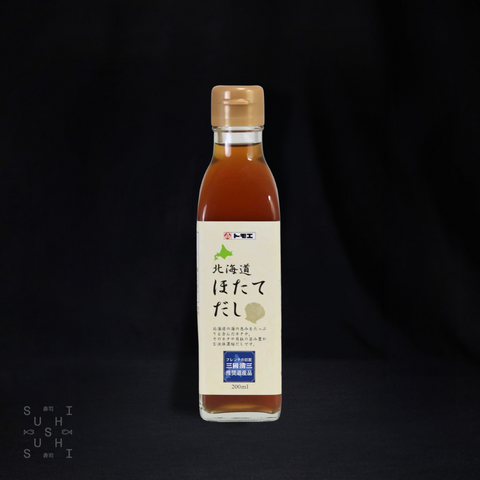
Tomoe, Hokkaido Scallop Dashi, 200ml
Concentrated Hokkaido scallop stock in a 200ml bottle. A splash gives a sauce, risotto or broth real shellfish sweetness in seconds.
Tomoe Hokkaido Hotate Dashi (北海道ほたてだし) is a liquid concentrate made from Hokkaido scallops. The label calls it a rich liquid dashi drawn from the umami of the scallop adductor. It is made in Sapporo by Fukuyama Jozo, a Hokkaido seasoning brewer founded in 1891, and the bottle carries the recommendation of chef Kiyomi Mikuni, one of Japan's best-known French chefs. It is also one James Martin has kept on his shelves. Because it is concentrated and seasoned, a little goes a long way.
Why Chefs Choose This
- Scallop sweetness on demand: the savoury sweetness of Hokkaido hotate without reducing a pot of shells
- Crosses over: it works as well in a beurre blanc or a risotto as in a Japanese broth, and does not read as fishy
- Fast: add it to a sauce, stock or rice at the pass and taste; there is no prep
- Small, useful bottle: 200ml suits an à la carte kitchen that wants a controlled dose of shellfish depth
How to Use
- Broths and soups: dilute with hot water or dashi for a clear scallop soup, noodle broth or nabe base, to taste
- Rice: add to the cooking water for takikomi gohan, fried rice or a seafood risotto
- Sauces: a spoonful into a butter sauce, velouté or cream sauce for fish and shellfish
- Dressings and marinades: a few drops in a soy and citrus dressing or a marinade for fish and vegetables
Hotate (帆立) is Japanese for scallop; the characters mean raised sail, from an old belief that scallops lifted one shell to sail across the sea. Hokkaido is Japan's scallop heartland, with the cold waters of the Sea of Okhotsk and the Pacific producing the large, sweet adductor muscles Japanese cooks prize, and dried Hokkaido scallops have long been a luxury ingredient in Japanese and Chinese kitchens. Fukuyama Jozo (福山醸造) has made soy sauce and seasonings in Sapporo since 1891 under the Tomoe (トモエ) brand. The bottle is marked as a Hokkaido product recommended by Kiyomi Mikuni, the Hokkaido-born French chef.
Learn more: Dashi
What does scallop dashi taste like?
Sweet and savoury, like the liquor left in the pan after searing scallops, only cleaner. It is lighter than a fish stock and sweeter than kombu dashi, with a rounded shellfish umami that does not linger or turn fishy. Straight from the bottle it is salty and intense, as a concentrate should be. Diluted, or stirred into butter, cream or rice, the salt fades into the background and what you notice is depth: the sauce tastes more of the sea and more finished, without anyone being able to point to why.
Product Details
| Type | Concentrated liquid scallop dashi (ほたてだし) |
| Brand | Tomoe (トモエ) |
| Maker | Fukuyama Jozo Co., Ltd. (福山醸造), Sapporo, founded 1891 |
| Scallops | Hokkaido |
| Volume and Format | 200ml glass bottle |
| Storage | Cool and out of direct sunlight before opening; refrigerate once opened |
| Best Used As | Broths, rice dishes, sauces, dressings and marinades |
How much scallop dashi should I use?
Treat it as a concentrate and add to taste. It is already seasoned and quite salty, so start small: a teaspoon or two in a sauce or a portion of risotto, or dilute with hot water or plain dashi for a broth, tasting as you go. Adjust the salt in the rest of the dish once it is in, not before.
Why Hokkaido scallops?
Hokkaido is Japan's main scallop region. Cold, nutrient-rich water in the Sea of Okhotsk and the northern Pacific grows large, sweet adductor muscles, and Hokkaido hotate are the benchmark for scallops in Japan. This dashi is made from them, in Sapporo, by a Hokkaido company.
Can I use it in non-Japanese dishes?
Yes, and many UK chefs do. Its sweetness suits French and Italian cooking: a butter sauce for turbot or scallops, a velouté, a seafood risotto, the water for a shellfish pasta. It adds depth without announcing itself as Japanese. It is also good in Chinese-style fried rice and steamed dishes, where dried scallop is a classic flavour.
SKU : S0397