


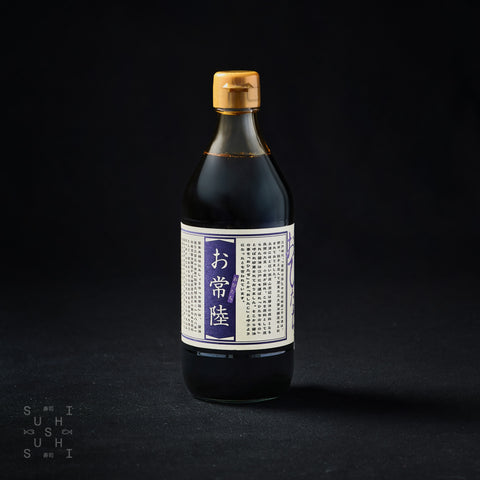
Shibanuma, Ohitachi Raw Soy Sauce, 500ml
Raw, unpasteurised soy sauce from a brewery founded in 1688.
This is soy sauce as a finishing seasoning, not a workhorse. Shibanuma's Ohitachi (お常陸) is a nama shoyu, raw and unpasteurised, which keeps the fresh, aromatic top notes that heat drives off, giving a brighter, more fragrant soy than a standard bottle. It is brewed in Ibaraki by Shibanuma, founded in 1688, and matured in wooden barrels, with a golden depth and a refined umami made for sashimi, sushi and the table. 500ml glass bottle.
More from Shibanuma: Barrel-Aged Unpasteurised Soy Sauce, 300g and Classic Yuzu Ponzu, 300ml.
Why Chefs Choose This
- Raw and unpasteurised: a nama shoyu, keeping the fresh, fragrant aromatics that pasteurising removes.
- Barrel-aged depth: matured in wooden barrels for a golden, layered umami.
- Real heritage: from Shibanuma, brewing in Ibaraki since 1688.
- Built for the table: made to be tasted raw, where a cooking soy would fall flat.
How to Use
- As a dipping soy: for sashimi, sushi and gyoza, where its fragrance shows.
- To finish: a few drops over a finished dish or rice bowl rather than cooked in.
- In dressings: mixed with mirin over edamame, salads or chilled vegetables.
- Beyond Japan: a few drops on beef tartare, burrata or a ripe tomato salad.
Most soy sauce is pasteurised, heated at the end of brewing to stabilise it, which also dulls some of its fresh aroma. A nama shoyu (生醤油, raw soy sauce) skips that heat, so it keeps the bright, lively character of freshly pressed soy: more aromatic, if more delicate. The name on the label, お常陸 (Ohitachi), draws on Hitachi (常陸), the old provincial name for the area that is now Ibaraki, where Shibanuma has brewed since 1688. The brewery matures its soy in wooden barrels, which hold their own microflora and add depth. This is soy sauce treated as a fine seasoning in its own right.
Learn more: What Is Soy Sauce?
What is the difference between raw and regular soy sauce?
Pasteurisation. Standard soy sauce is heated at the end of brewing, which stabilises it and gives a familiar, slightly cooked depth. A raw (nama) soy sauce is bottled without that heat treatment, so it keeps the fresher, brighter, more fragrant aromatics of the soy as it comes from the press. The result is more delicate and aromatic, better as a finishing and dipping soy than as a cooking workhorse, and best kept cool and used while fresh. For sashimi and sushi, where the soy is tasted raw, that extra fragrance is exactly what you want.
| Type | Nama shoyu 生醤油 (raw, unpasteurised soy sauce) |
| Brand | Shibanuma (founded 1688), Ibaraki |
| Key Feature | Unpasteurised, matured in wooden barrels |
| Origin | Ibaraki, Japan |
| Net Volume / Format | 500ml glass bottle |
| Best Used As | Dipping and finishing soy for sashimi, sushi and the table |
What does "Ohitachi" mean?
Ohitachi (お常陸) refers to Hitachi (常陸), the old provincial name for the region that is now Ibaraki Prefecture, where Shibanuma has brewed soy sauce since 1688. It is a mark of place rather than a style, signalling a soy sauce rooted in that region and its long brewing tradition.
How should I use a raw soy sauce like this?
Use it where its fragrance can be appreciated raw: as a dipping soy for sashimi, sushi and gyoza, as a finishing drizzle over a completed dish or rice bowl, and in light dressings and delicate marinades. It is wasted boiled hard into a long-cooked sauce, where its fresh top notes are lost; for that, an everyday cooking soy is the better choice. Keep this one for the moments where the soy itself is on show.
How should I store it?
Because it is raw and unpasteurised, keep it cool, refrigerate after opening and use it while fresh to enjoy its aromatics at their best. Keep it out of direct sunlight and heat, which dull soy sauce over time. Treated this way it stays bright and fragrant; left warm and open it will gradually lose the very freshness that sets a nama shoyu apart.
SKU : S0403