


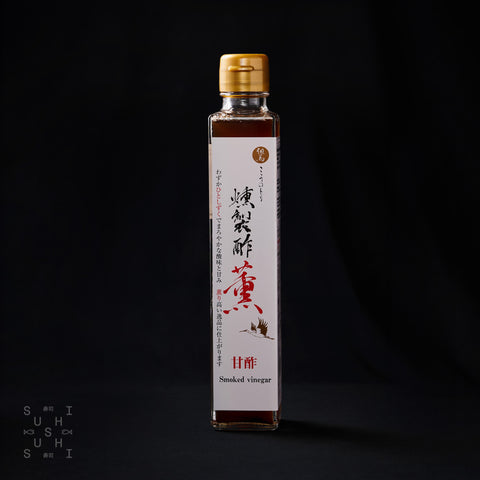
Tajima, Sakura Smoked Vinegar, 200ml
Smoke and Acidity in One Bottle, From Britain's Best Kitchens
A few drops of this do the work of a smoker and a vinegar at once. Tajima Sakura Smoked Vinegar is Kaoru (薫), a rare sweet smoked vinegar (amazu, 甘酢) from the Tajima Jōzōsho vinegar brewery in Hyōgo. It is built on the brewery's own junmai rice vinegar smoked over sakura (cherry) chips, so it carries a mellow acidity and a gentle sweetness wrapped in soft wood smoke. It is a quiet weapon on the pass, which is why it turns up in kitchens including Andrew Wong of two-Michelin-star A. Wong, Rafael Cagali of two-star Da Terra, Kirk Haworth at Plates, Ayo Adeyemi at Akoko and Jean Delport at Interlude. A 200ml bottle of finishing vinegar goes a long way.
Pairs with: Tamanoi Japanese Rice Vinegar, 500ml and Tamanoi Sushi Vinegar with Dashi, 360ml.
Why Chefs Choose This
- Smoke and acidity at once: adds both in a few drops, no smoker or extra step needed at the pass
- Cherry-wood smoke: built on a rice vinegar smoked over sakura chips, for a soft, aromatic smoke rather than a harsh one
- Used in top kitchens: on the pass at two-star A. Wong and Da Terra, plus Plates, Akoko and Interlude, among others
- A little goes far: assertive enough to finish a dish in drops, so a 200ml bottle lasts across a long service life
How to Use
- Finish at the pass: a few drops over grilled meat, fish or roasted vegetables just before serving
- Dressings and ponzu: build into vinaigrettes, ponzu and dipping sauces for smoke alongside the tang
- Sushi rice and sunomono: a few drops in sushi rice, vinegared salads or nanban-zuke, as the brewery suggests
- Beyond Japanese: anywhere smoke and acidity help, from pulses and roast roots to barbecue
燻製酢: Smoked Vinegar
Kunsei-su (燻製酢) simply means smoked vinegar, from kunsei (燻製, smoked) and su (酢, vinegar). Smoking is an old Japanese preserving and flavouring craft, most famously applied to katsuobushi, the smoke-dried bonito at the heart of dashi; here the same idea is turned on vinegar. The base is a junmai rice vinegar from Tajima Jōzōsho (但馬醸造所), a brewery in Yabu, in the Tajima district of northern Hyōgo, which ferments its vinegar slowly by the traditional static method. It is smoked over sakura, cherry wood, prized in Japanese smoking for a gentle, fragrant smoke, then sweetened into amazu (甘酢, sweet vinegar). The result is unusual: most vinegars give you only acidity, while this carries a layer of smoke that would otherwise take a grill or a smoking gun to achieve.
Learn more: What is Japanese Black Vinegar?
What does smoked vinegar taste like?
First the smoke, soft and aromatic rather than acrid, then a mellow acidity and a gentle sweetness underneath. It is softer than a plain rice vinegar: the label promises mellow sourness and sweetness, and the wood smoke rounds the edges further and adds a savoury, almost barbecue-like depth. Because both elements are concentrated, it reads as assertive, so it is used in drops and small spoonfuls rather than splashes. Think of it as a seasoning that brings acidity and smoke together, the kind of finishing touch that makes a plate taste considered without anyone being able to say why.
Product Details
| Type | Sweet smoked vinegar (燻製酢 薫 甘酢, kunsei-su Kaoru amazu) |
| Brand | Tajima Jōzōsho 但馬醸造所, Yabu, Hyōgo |
| Smoking Wood | Sakura (cherry) chips, on a junmai rice vinegar base |
| Origin | Hyōgo, Japan |
| Volume | 200ml glass bottle |
| Best Used As | Finishing and dressing vinegar |
| Storage | Ambient before opening; refrigerate after opening |
What is smoked vinegar (kunsei-su)?
It is vinegar that has been smoked over wood after fermentation, so it carries smoke as well as acidity. This one is built on a rice vinegar smoked over sakura (cherry) chips and then sweetened, giving a gentle, aromatic smoke rather than a harsh one. Smoking is a long-standing Japanese flavouring craft, best known from katsuobushi (smoke-dried bonito); applied to vinegar it produces a finishing condiment that adds both tang and a savoury, barbecue-like depth in a single bottle.
How do you use smoked vinegar?
Use it where you want acidity and a hint of smoke at once, and use it sparingly. The main applications are finishing (a few drops over grilled meat, fish or vegetables at the pass), dressings (vinaigrettes, ponzu and dipping sauces), and glazes or marinades warmed gently so the aroma is not driven off. It also works well beyond Japanese cooking, anywhere a smoky acidity lifts a dish, from pulses and roast vegetables to barbecue. Because it is concentrated, start with less than you think.
How is it different from regular rice vinegar?
A rice vinegar gives you clean acidity for the jobs you reach for in volume, seasoning sushi rice, pickling and dressings. Smoked vinegar is a specialist finisher: it adds smoke and a little sweetness as well as acid, and is used in drops, not splashes. The two are complementary rather than interchangeable. For that base acidity Iio Jozo rice vinegar is a benchmark, as is Tamanoi for everyday volume; keep the smoked vinegar for finishing and for dishes that want an extra savoury, smoky layer.
SKU : S0025