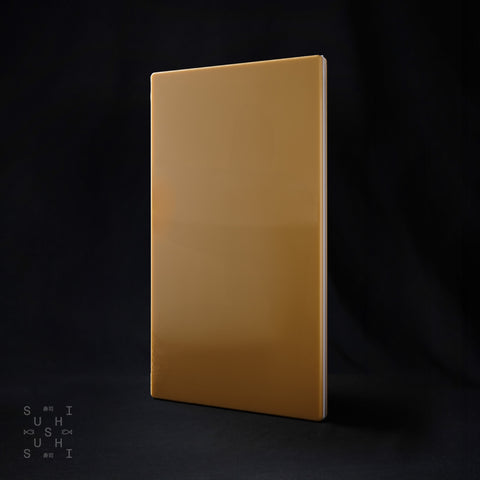


Hasegawa Soft Cutting Board 600mm
600 x 300 x 20mm, 2.4kg. A wood core sealed in soft synthetic rubber: kind to your knife edge, grippy under the fish, and dishwasher safe.
This is the Hasegawa FSR20-6030 soft cutting board, the 600 x 300mm size in Hasegawa's wood-core range. A 10mm broadleaf wood core sits between two 5mm layers of soft elastomer, with polyethylene edges, and the wood is fully enclosed. The result is a board that gives slightly under the blade like good wood, stays flat through hot washes like plastic, and weighs noticeably less than a solid plastic board of the same size. At 600mm it covers a full section of prep, from breaking down a side of salmon to slicing sashimi.
Why Chefs Choose This
- Easy on edges: the soft surface absorbs the impact of the blade, so fine Japanese edges stay sharp for longer.
- Food stays put: the slightly tacky surface grips fish and vegetables, which helps with long pull cuts and thin slicing.
- Lighter to handle: the wood core makes it roughly 30% lighter than a solid plastic board of the same size, which matters at the sink.
- Stays flat: the enclosed core resists warping through repeated high-temperature washing.
How to Use
- Fish prep: fillet, skin and portion fish on a board that grips and will not blunt a deba or yanagiba.
- Sashimi and sushi: slice with long single strokes; the soft surface lets the edge glide through.
- Transfer: the board flexes a little, so you can tip chopped ingredients into a pan or bowl.
- Keep it clean: use the Hasegawa scraper to lift knife marks and keep the surface smooth.
Hasegawa Chemical Industry (長谷川化学工業) makes cutting boards in Japan for home and professional kitchens. Traditionally, Japanese chefs cut on wooden manaita (まな板) of hinoki or ginkgo because soft wood is kind to single-bevel knives. Plastic boards are easier to keep hygienic but tend to be hard and heavy. The wood-core soft board is Hasegawa's answer to both: the cushion and grip of a wooden board on the surface, a sealed wooden core for rigidity and low weight, and a finish that goes through a commercial dishwasher.
Learn more: Japanese Kitchen Knives
Is a wood-core board hygienic?
Yes, in normal use. The wood is sealed inside the board, under 5mm of synthetic rubber on each face and polyethylene on the edges, so food never touches it. The surfaces are dishwasher safe and can be bleached, and the board tolerates temperatures from minus 30°C up to 90°C. The only way to expose the core is serious abuse, such as hacking through bone with a heavy cleaver or cutting through the edge. Scrape the surface smooth from time to time and it will stay easy to clean.
Product Details
| Type | Soft cutting board with wood core (まな板) |
| Maker and Model | Hasegawa, FSR20-6030 |
| Dimensions | 600 x 300 x 20mm |
| Weight | 2.4kg |
| Construction | 5mm soft synthetic rubber each face, 10mm broadleaf wood core, polyethylene edges |
| Temperature Range | Minus 30°C to 90°C |
| Cleaning | Dishwasher safe, bleach safe |
| Origin | Japan |
Will it blunt my knives?
Less than almost any other board. The soft rubber surface gives slightly under the edge instead of resisting it, which is what dulls a blade on hard plastic, glass or stone. That makes it a good match for thin, hard Japanese blades such as yanagiba and gyuto. Keep cutting on the flat of the board rather than the edges for the best result.
Can it go in the dishwasher?
Yes. The board is dishwasher safe and can be sanitised with chlorine bleach. Its temperature range runs up to 90°C, and the wood core is there partly so the board does not warp with repeated hot washes. Let it dry standing on its edge, and avoid leaving it in direct sunlight, which can age the surface.
How do I remove knife marks and stains?
Use the Hasegawa scraper to shave off a thin layer of the surface, which removes cut marks and ingrained stains and leaves it smooth again. A diluted bleach soak deals with discolouration. Regular scraping keeps the board hygienic and extends its working life.
SKU : T3024