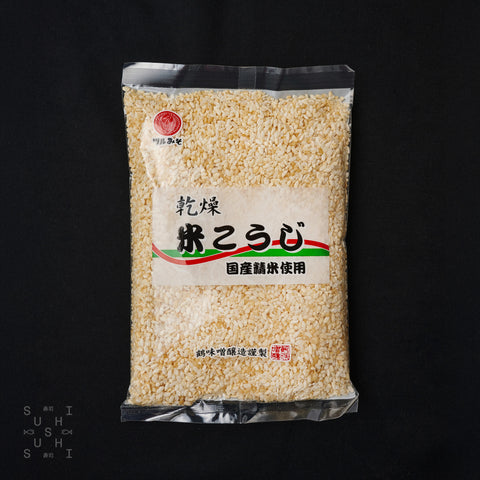
Tsurumiso, Dried Rice Koji, 500g
Without Koji, There Is No Miso. No Sake. No Mirin. No Soy Sauce.
Aspergillus oryzae — the mould that grows on steamed rice under controlled warmth and humidity — is the founding enzyme of Japanese fermentation. Every major fermented condiment in the Japanese kitchen traces back to it: miso, sake, mirin, soy sauce, amazake, shio koji. The mould produces three enzyme families (amylase for starch conversion, protease for protein breakdown, lipase for fat processing) and the interplay of those enzymes with different substrates over different fermentation periods produces the full range of Japanese fermented flavour. This dried rice koji from Tsurumiso — a miso and fermented foods producer from Aichi Prefecture — is steamed rice inoculated with Aspergillus oryzae, incubated until the mould has penetrated the grain, and then dried for shelf stability. The dried format gives consistent spore activity, a long shelf life, and reliable, predictable fermentation — important when you are making shio koji for service or building miso in-house for the first time.
Why Chefs Choose This
- Shio koji in 72 hours: Mix dried koji with salt and water, leave at room temperature for three days, and you have shio koji — a fermented salt with protease enzymes that tenderise protein, build umami, and season more evenly than straight salt. The simplest application of koji and one of the most useful things a kitchen can make in-house
- Dried format means consistency: Fresh koji has variable spore count and short shelf life. Dried rice koji maintains consistent enzyme activity, orders on demand, and holds for two years unopened — the professional kitchen's version of this ingredient
- One raw material, many outputs: The same bag makes shio koji for protein work, amazake for dessert and drink applications, pickling brine, koji butter, and the base for in-house miso. High versatility per shelf space
- Made by a miso producer: Tsurumiso have been producing miso and fermented foods in Aichi Prefecture for generations — they understand koji behaviour across the full fermentation arc, not just as a commodity ingredient
How to Use
- Shio koji (the essential start): Combine 200g dried rice koji, 60g fine sea salt, and 250ml water in a clean jar. Stir once a day for 3–5 days at room temperature (20–25°C) until it smells sweet and slightly alcoholic. Use as a marinade, rub, or seasoning — 1 tablespoon replaces conventional salt in most applications
- Protein marination: Coat fish, chicken, or pork in shio koji for 30 minutes to several hours before cooking. The protease enzymes break down surface protein, tenderising texture and building umami without the acidity of a vinegar-based marinade
- Amazake base: Cook koji with water and cooked rice at 55–60°C for 6–8 hours to produce amazake — a naturally sweet fermented rice drink used as a dessert base, glazing liquid, or pastry sweetener
- Koji pickles: Combine with cucumber, daikon, or carrot and a small amount of salt. Two hours gives a light, enzyme-brightened pickle; overnight gives deeper umami penetration
麹 — The National Microorganism of Japan
In 2006, the Brewing Society of Japan formally designated Aspergillus oryzae as "the national microorganism" (国菌, kokkin) of Japan — a recognition of how comprehensively a single mould underpins Japanese food culture. The relationship between Japanese cuisine and Aspergillus oryzae stretches back over a thousand years, appearing in Heian-era records and forming the basis of the sake industry that developed through the medieval period. The word koji (麹 or 糀, the second character showing rice with flowers growing from it) refers specifically to grain inoculated with the mould — most commonly rice (kome koji, 米麹), but also barley (mugi koji) and soybean (mame koji). Each grain produces a different enzyme balance and a different fermented character. Tsurumiso in Aichi Prefecture sits in the heartland of Japanese miso production — the hatcho miso tradition of Okazaki (long-fermented soybean miso) and the sweeter shiro miso of the wider Aichi region are both koji-dependent, and a miso producer's understanding of how koji behaves under different conditions is the professional context in which this product was made.
What does shio koji taste like?
Shio koji is salty — that is its primary function. But the salt is accompanied by a mild sweetness from the glucose released as the koji amylase breaks down rice starch, and a subtle savouriness from the amino acids produced as the protease enzymes work. The taste is rounded rather than sharp, with a faint grain aroma and a clean finish. When used as a marinade, the enzymes cross over to the protein: fish cooked with shio koji tastes noticeably more savoury and has a slightly caramelised surface from the sugars browning under heat. The underlying flavour of the shio koji itself is mild enough that it enhances rather than flavours — which is why it works across fish, poultry, pork, and vegetables without creating a recognisably Japanese character in the finished dish.
Product Details
| Product Type | 乾燥米麹 — Dried Rice Koji (Kome Koji) |
| Brand | Tsurumiso (つるみそ) |
| Culture | Aspergillus oryzae on steamed rice |
| Prefecture | Aichi, Japan |
| Format | Dried (shelf-stable) |
| Net Weight | 500g |
| Storage | Cool, dry place; refrigerate after opening |
How do I make shio koji from dried rice koji?
Combine 200g dried rice koji, 60g fine sea salt (30% of the koji weight), and 250ml water in a clean glass jar. Stir thoroughly until the salt dissolves. Leave at room temperature (18–25°C), stirring once a day. After 3–5 days the mixture will smell mildly sweet and slightly alcoholic — this is the active enzymes working. At this point the shio koji is ready. It will keep refrigerated for up to 3 months. Use 1–2 tablespoons per 100g of protein as a marinade; for seasoning, substitute 1 tablespoon of shio koji for approximately half a teaspoon of fine salt.
What is the difference between dried and fresh koji?
Fresh koji has active, living mould with high enzyme activity — it is more powerful and faster, but perishable within a week or two even refrigerated. Dried koji has been gently dehydrated to stop active mould growth while preserving the enzyme content. It is slower to activate (the enzymes need to rehydrate before working) but stores for up to two years, orders on demand, and gives more consistent results between batches. For a professional kitchen using koji as an ingredient rather than in a continuous fermentation programme, dried is the more practical format. Results are equivalent in finished flavour — the main difference is timing.
What else can I make beyond shio koji?
Shio koji is the simplest starting point but dried rice koji has a wider range. Amazake: cook koji with softened rice or rice porridge at 55–60°C for 6–8 hours to produce a naturally sweet, low-alcohol fermented rice drink — used as a dessert base, alternative sweetener, or glazing liquid for pastry work. Koji pickles: mix with salt and vegetables for enzyme-bright quick pickles in 2–24 hours. Koji butter: blend rehydrated koji into softened unsalted butter for an umami compound butter. In-house miso: mix with cooked soybeans, salt, and a small amount of starter miso and pack into a sealed container — fermentation takes 6–12 months at room temperature and produces a genuinely distinctive miso suited to the kitchen that made it.
SKU : S0315