
Best Dashi UK: 5 Picks for 2026
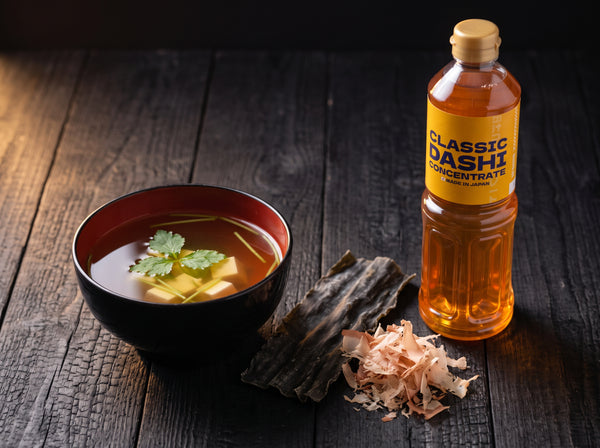
Dashi (出汁) is the stock at the base of Japanese cooking. Japan's agriculture ministry, MAFF, describes the basic dashi as kombu and bonito flakes, with the glutamic acid in the kombu and the inosinic acid in the bonito combining into a deep umami taste, and dates the technique to about 500 years ago. Made fresh, it takes kombu, katsuobushi and a little time; instant granules and liquid concentrates exist so a busy kitchen can have it on demand. This guide picks five, starting with our own Kōmi range, and tells you plainly what is in each one.
Source: MAFF, Washoku World Challenge (5th), umami theme page.
| Product | Best for | Price |
|---|---|---|
| Kōmi Shiro Dashi Concentrate, 1L | Fast, pale dashi for broths, soups and egg dishes | £14.99 |
| Kōmi Ma Kombu: 3-year aged Kurokuchi-hama 50g, or 10-year aged Shirokuchi-hama 500g | Making dashi from scratch | £19.99 / £149.99 |
| Shimaya Dashi no Moto Powder, 50g | Everyday bonito dashi in sachets | £2.99 |
| Marutomo Katsuo Dashi Powder, 1kg | Kitchens using bonito dashi daily | £19.99 |
| Marutomo Kombu Dashi Stock Powder, 1kg | Kelp dashi in volume, with no fish in the ingredients | £19.99 |
1. Kōmi Shiro Dashi Concentrate, 1L: best all-round dashi
Kōmi is our own range. This shiro dashi is made for us by Ninben, the Nihonbashi katsuobushi house founded in 1699. Shirodashi (白だし) is a liquid dashi concentrate made to keep dishes light in colour, and Ninben recommends it for oden, hot pot, udon broth, clear soups, chawanmushi, rolled omelette and rice cooked with ingredients.
- The dashi comes from three dried fish, skipjack tuna, mackerel and bullet tuna, with fish extract and a little kelp, seasoned with soy sauce, salt, sugar and vinegar.
- Ninben's guide for one bowl of udon broth is 30ml shirodashi to 270ml water; for chawanmushi with two eggs, 30ml to 360ml water.
- Salt is 12.9g per 100ml, so it is a concentrate: dilute it, never use it neat.
- Keep it somewhere cool and dry, and refrigerate it once opened. A 1L bottle keeps 12 months unopened.
Worth knowing: it contains fish, soy and wheat, so it is not suitable for vegetarians.

Source: SushiSushi product specification K0003, Kōmi Shiro Dashi Concentrate, made by Ninben, accurate as of 21 July 2026; Ninben, dashi methods and shirodashi pages (retrieved 3 August 2026).
2. Kōmi Ma Kombu, 3-year and 10-year aged: best for dashi from scratch
Kōmi Ma Kombu is ma kombu (真昆布) from two named Hokkaido harvesting beaches, supplied by NaniwaKombu. The 50g pack is Kurokuchi-hama kombu aged for 3 years; the 500g pack is Shirokuchi-hama kombu aged for 10 years, the longer-aged and higher-priced of the two. Kombu brings glutamic acid to dashi; paired with katsuobushi it makes awase dashi, which MAFF describes as the basic dashi of Japanese cooking.
- Ninben's awase dashi uses 10g kombu and 20g katsuobushi to a litre of water: soak the kombu 30 to 60 minutes, heat to about 80°C, lift the kombu out before it boils, return to the boil, add the katsuobushi, wait 2 minutes and strain.
- Start with the 50g Kurokuchi-hama pack for home cooking; the 500g Shirokuchi-hama is for kitchens making dashi every day.
Worth knowing: kombu is the slow route: allow time to soak. For speed, use the Kōmi shiro dashi above.


Source: NaniwaKombu product offer sheet via KC Central (May 2025); SushiSushi product records for ageing; Ninben dashi methods; MAFF Washoku World Challenge (archived copy).
3. Shimaya Dashi no Moto Powder, 50g: best for everyday bonito dashi
Shimaya's Dashi no Moto is a bonito-flavoured soup stock powder in ten 5g sachets, made at Shimaya's factory in Shūnan, Yamaguchi. Its ingredients are glucose, MSG, salt, dried bonito powder, bonito extract, yeast extract and the flavour enhancer E635. There is no kelp in it, so it is a bonito dashi, not an awase blend.
- Dissolve 1% to 2% in hot water, so one 5g sachet makes roughly 250ml to 500ml of stock.
- Keeps 18 months unopened at room temperature; once open, Shimaya says seal it, refrigerate it and use it soon.
- Salt is about 37g per 100g of powder, so go easy on soy and salt elsewhere in the dish.
Worth knowing: it contains bonito, so it is not suitable for fish-free or vegetarian cooking. For a rounder awase taste, use it alongside a kombu dashi.

Source: Shimaya product specification, Bonito flavored soup stock powder 50g, dated 7 February 2023.
4. Marutomo Katsuo Dashi Powder, 1kg: best for kitchens using bonito dashi daily
Marutomo of Iyo, Ehime, makes this as Shin Katsuo Dashinomoto: soluble bonito-stock granules packed as two 500g bags. By weight it is about 8.5% dried bonito, with flavour enhancers (MSG, disodium inosinate, disodium guanylate) and salt making up most of the rest, plus sugar, yeast extract and protein hydrolysate.
- Marutomo's guide is about one teaspoon (4g) for 600ml of miso soup for four.
- Listed uses: miso soup, hot and cold noodle soups, stewed dishes and oden.
- Keeps 24 months unopened; after opening, seal the bag and keep it away from moisture.
Worth knowing: there is no kombu in the mix, so it gives bonito umami only. Salt is 45.8g per 100g. 1kg is a lot of dashi if you only cook Japanese food now and then.

Source: Marutomo specification, EU Shin Katsuo Dashinomoto 1kg (2021).
5. Marutomo Kombu Dashi Stock Powder, 1kg: best for kelp dashi in volume
Marutomo's kombu stock is a soluble kelp dashi powder in a 1kg pack. Its blend is MSG, salt and sugar with dextrose, kombu powder and kombu extract, plus the flavour enhancers disodium inosinate and disodium guanylate. Kombu is the only flavour ingredient, and no fish appears in the ingredient list.
- Dissolve it straight into hot water for a quick kelp stock, then season to taste.
- Keeps 24 months unopened.
- Salt is 48.3g per 100g, so add salt and soy carefully.
Worth knowing: it contains none of the UK's 14 allergens, but Marutomo's factory also handles fish, crustaceans and molluscs, so it may contain traces. It is not certified vegetarian or vegan.

Source: SushiSushi product specification S0285, Marutomo Kombu Stock 1kg, accurate as of 19 May 2026.
How to choose a dashi
Powder or liquid? The powders above dissolve straight into hot water and keep 18 to 24 months unopened at room temperature. Shimaya asks for refrigeration once opened; Marutomo asks you to seal the bag and keep it dry. Shirodashi, such as Kōmi's, is a liquid concentrate you dilute to a ratio.
Bonito, kombu or both? Bonito brings inosinic acid and kombu brings glutamic acid. MAFF calls the two together the basic dashi, and the Umami Information Center measures the pair at 7 to 8 times the umami of either alone at a 1:1 ratio. If your powder is bonito only, adding kombu gets you there.
Want it from scratch? Ninben's awase dashi uses 10g kombu and 20g katsuobushi to a litre of water: soak the kombu 30 to 60 minutes, heat to about 80°C, lift the kombu out before it boils, return to the boil, add the katsuobushi, wait 2 minutes and strain.
Source: Shimaya and Marutomo specifications; MAFF Washoku World Challenge; Umami Information Center; Ninben dashi methods.
Dashi FAQ
What is the difference between katsuo dashi and kombu dashi?
Katsuo dashi is made from bonito (katsuobushi) and carries inosinic acid; kombu dashi is made from kelp and carries glutamic acid. Combined, they make awase dashi, which MAFF describes as the basic dashi of Japanese cooking.
How much dashi powder do I use?
Follow the pack. Shimaya specifies dissolving 1% to 2% in water; Marutomo suggests about 4g for 600ml of miso soup. Instant dashi is salty (37 to 48g salt per 100g in the powders above), so taste before adding more salt or soy.
Is kombu dashi powder fish-free?
The Marutomo kombu stock lists no fish ingredient, but it is made where fish is handled, so it may contain traces. It is not certified vegetarian or vegan, so check the label if you need that assurance.
How should I store dashi powder?
Unopened, keep it at room temperature away from direct sunlight. Once opened, seal it and keep it dry; Shimaya also asks you to refrigerate its powders. Fresh homemade dashi should be used the same day or frozen in small portions for up to 2 weeks (Ninben).
Shop the full dashi range
See every dashi we stock, from granules to concentrates, in our Dashi collection.
Sources for this page: SushiSushi Masterclass record "Dashi" (store/dashi/dashi.md), drawing on the SushiSushi Kōmi K0003 specification (July 2026), the SushiSushi Marutomo S0285 specification (May 2026), the NaniwaKombu offer sheet (May 2025), Shimaya product specifications (2021, 2023), Marutomo product specifications (2021, 2025), Ninben's dashi and shirodashi pages (© 株式会社にんべん, retrieved 3 August 2026), MAFF's Washoku World Challenge 5th competition page (archived copy, captured 11 March 2022), and the Umami Information Center (© Umami Information Center). Facts are reworded; no text is reproduced.

