
Dashi and Umami: The Complete Guide
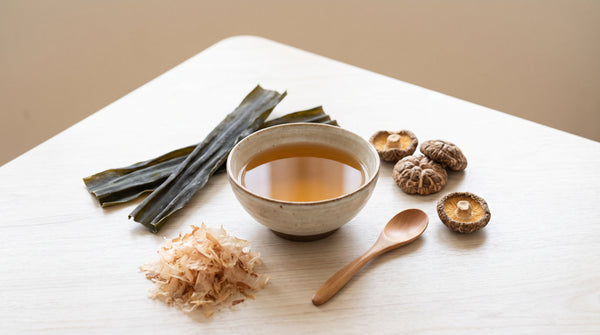
Almost everything that makes Japanese food taste deep and satisfying comes back to two linked ideas: umami, the savoury fifth taste, and dashi, the stock that delivers it. Understand the pair and the whole cuisine makes more sense. This is the hub that connects them and points you to each guide.
The short version: umami comes from glutamate and two nucleotides, inosinate and guanylate. Kombu is rich in glutamate, katsuobushi in inosinate, and combining the two multiplies the savoury effect far beyond either alone. Dashi is simply the most efficient way to put that pairing to work. Start here, then dig into each piece.
Umami: the fifth taste
Umami is the savoury fifth basic taste, alongside sweet, salty, sour and bitter. It comes from glutamate and the nucleotides inosinate and guanylate, spreads across the whole tongue and lingers, and it lets you add depth to a dish without adding salt. It is the science that explains why dashi works.
The full concept guide covers the compounds, the synergy effect and the history: what umami is.
Source: our umami guide (store/umami/umami.md, COMPLETE), which carries its own full citation list.
Kombu: the glutamate source
Kombu is dried kelp and one of the richest natural sources of glutamate, the dominant umami compound. It is the vegetarian backbone of dashi and turns plain water into a savoury base with no fishiness and no salt. It supplies the glutamate half of the classic umami pairing.
Read more in our guide to kombu.
Source: our kombu guide, already gated and cited on its own published page.
Katsuobushi: the inosinate source
Katsuobushi is dried, smoked and often fermented bonito, shaved into delicate flakes. Its umami comes from inosinate, and a bonito's freshness sets how much it carries. It is the inosinate half of dashi, and the partner that makes kombu's glutamate sing.
See how it is made in our guide to katsuobushi.
Source: our katsuobushi guide, already gated and cited on its own published page.
Dashi: where it all comes together
Dashi is the Japanese stock that turns the umami principle into a usable base. Classic ichiban dashi pairs kombu (glutamate) with katsuobushi (inosinate) at close to a one-to-one ratio, which is exactly the combination that multiplies perceived umami seven to eightfold. It is the single most useful thing to learn in a Japanese kitchen.
Our dashi guide walks through the method.
Source: the umami and katsuobushi records' shared account of ichiban dashi ratios and synergy; the linked dashi page is the older, not-yet-rebuilt format and is held for a future refresh.
Frequently Asked Questions
What is the link between umami and dashi?
Umami is the savoury taste; dashi is the stock that delivers it. Dashi pairs a glutamate source (kombu) with an inosinate source (katsuobushi), and that specific pairing multiplies umami far beyond either ingredient alone. So dashi is umami science put to practical use in a pot.
Why do kombu and katsuobushi go together?
Because they supply different umami compounds. Kombu is rich in glutamate, katsuobushi in inosinate, and combining a glutamate source with a nucleotide source produces umami synergy: at a one-to-one ratio, perceived umami reaches seven to eight times the intensity of either alone. That is why classic dashi uses both.
Can I make dashi without fish?
Yes. Kombu on its own makes a clean vegetarian dashi, since kombu carries the glutamate. Pairing it with dried shiitake, which supplies the nucleotide guanylate, gives a fully plant-based dashi that still benefits from umami synergy.
Shop dashi ingredients
Keep the essentials to hand: kombu and katsuobushi for dashi, with fast UK delivery, so you can build a proper savoury base from scratch.
Drawn from our cited Masterclass guides to umami, kombu and katsuobushi. Each linked guide carries its own sources.

