Soba Noodles and Toshikoshi Soba: Japan's Buckwheat Noodle
Soba (蕎麦) is Japan's buckwheat noodle: buckwheat flour mixed with a binder and water, kneaded, rolled and cut into long strands. It is an everyday food across Japan, and on New Year's Eve people all over the country eat toshikoshi soba, a custom that became national after the Meiji era.
This guide covers what soba is, why it matters at New Year, the famous regional styles and how to serve it at home. It sits inside our Pantry Masterclass.

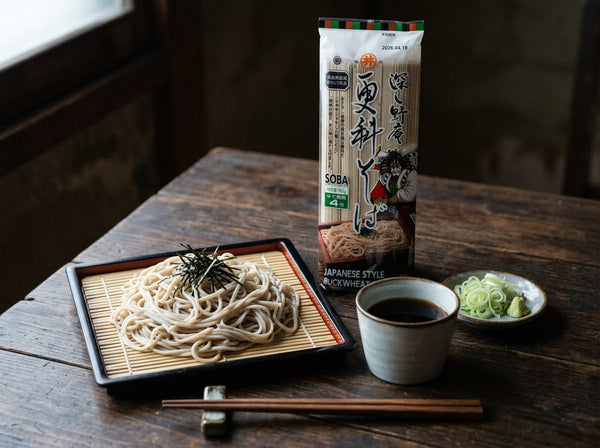
Our soba: Toa Dried Soba Noodles, 180g, a Sarashina-style soba (更科そば) ready in four minutes.
What Is Soba?
Buckwheat was eaten in Japan long before noodles, as a dough or as whole grain. Cut noodles, soba-kiri, were served at temples in the early Edo period and then sold in Edo's shops next to udon. People in Edo, now Tokyo, came to prefer soba to udon, which is why Japan still says udon in the west, soba in the east. By the late Edo period soba houses served cold mori soba and hot bowls topped with tempura, duck (kamo nanban) and more.
There are two basic ways to eat it: mori soba, cold noodles dipped in a cup of tsuyu, and kake soba, noodles in a bowl of hot broth. Spring onion and shredded nori are the usual garnishes.
Source: Ministry of Agriculture, Forestry and Fisheries of Japan, Uchi no Kyōdo Ryōri (regional cuisine) page for Tokyo soba. Facts extracted and reworded.
What Is Toshikoshi Soba?

Toshikoshi soba (年越しそば), year-crossing soba, is the bowl eaten on New Year's Eve. Japan's Ministry of Agriculture (MAFF) gives the common explanations: long thin noodles stand for a long life and a family's fortunes stretching on, and because soba breaks easily it cuts away the year's troubles before the new one starts.
In the Edo period soba was already eaten at the end of each month (misoka soba) and at the change of season (setsubun soba). Eating it on New Year's Eve became a national custom only after the Meiji era. A related custom is hikkoshi soba, soba given to new neighbours when you move house, a pun on soba meaning both the noodle and nearby.
Source: Ministry of Agriculture, Forestry and Fisheries of Japan, Uchi no Kyōdo Ryōri (regional cuisine) pages. Facts extracted and reworded.
Japan's Regional Soba Styles
Every soba region has its own style. MAFF's regional cuisine pages describe four of the best known.
Edo soba, Tokyo. Tokyo's three historic soba houses each have their own look: Sunaba for thin white noodles, Sarashina for translucent ones, and Yabu for greenish noodles that get their colour from the inner skin of the buckwheat seed.
Shinshu soba, Nagano. Buckwheat grows where rice and wheat struggle, and Nagano's cold highlands, around 700 metres up with morning mist that shields the frost-tender plants, are known for it. Togakushi soba is rolled with a single pin and served in small bundles called botchi-mori. Nagano has more soba shops than any other prefecture, and Azumino grows over 90% of Nagano's wasabi, the usual soba condiment.
Izumo soba, Shimane. One of Japan's three great soba, with Iwate's wanko soba and Togakushi soba. It is darker than most because the whole buckwheat seed, husk included, is ground in (hikigurumi), and it uses only about 20% wheat as binder. It is served cold in stacked round lacquer boxes (warigo soba) with the tsuyu poured over, or hot and unrinsed with thick soba cooking water (kamaage soba).
Hegi soba, Niigata. Bound with funori seaweed instead of wheat, an idea borrowed from local weavers, who used funori to stiffen thread. The noodles are laid out in small hand-folded loops on a square wooden tray called a hegi, and eaten with mustard instead of wasabi, a little placed on the noodles rather than stirred into the dip.
Source: Ministry of Agriculture, Forestry and Fisheries of Japan, Uchi no Kyōdo Ryōri (regional cuisine) pages for Tokyo soba, Nagano teuchi soba, Izumo soba and Niigata hegi soba. Facts extracted and reworded.
When Is New Soba in Season?
Buckwheat is harvested twice a year, in summer (natsu-shin) and autumn (aki-shin). Autumn soba is generally thought to have the better aroma, colour and flavour. In Nagano, new soba from the autumn harvest reaches shops from mid-October to early November.
Source: Ministry of Agriculture, Forestry and Fisheries of Japan, Uchi no Kyōdo Ryōri (regional cuisine) pages. Facts extracted and reworded.
How to Cook Soba at Home
- Bring a large pan of water to the boil and cook the soba for the time on the pack: four minutes for Toa Dried Soba.
- Drain and rinse well under cold running water, then chill in iced water for cold soba.
- For mori or zaru soba, serve the cold noodles with a cup of tsuyu, spring onion and a little wasabi. For kake soba, put the rinsed noodles in a hot bowl and pour over hot broth.
- Eat it soon after cooking. Nagano's recipe on the MAFF pages says soba tastes best within two minutes of boiling.
For a hot bowl, see our soba noodle soup recipe.
Source: Toa product specification; Ministry of Agriculture, Forestry and Fisheries of Japan, Uchi no Kyōdo Ryōri page for Nagano teuchi soba. Facts extracted and reworded.
Popular Products

Toa Dried Soba Noodles, 180g
Sarashina soba (更科そば), air-dried in Hyōgo, at least 30% buckwheat, four minutes to cook.

Toa Premium Hokkaido Buckwheat Soba, 200g
Zaru soba made with Japanese-grown ingredients, for serving cold.


Frequently Asked Questions
What is soba made from?
Buckwheat flour, usually with a binder such as wheat flour, and water.
Why do Japanese people eat soba on New Year's Eve?
The long noodles stand for a long life, and because soba breaks easily it is said to cut away the old year's troubles.
Is soba gluten free?
Not usually. Most dried soba contains wheat flour as a binder. Our Toa Dried Soba lists wheat flour first, so it is not gluten free. Always check the pack.
Is soba eaten hot or cold?
Both: cold mori soba dipped in tsuyu, or hot kake soba in broth.
Why is some soba darker?
Flour ground from more of the seed and husk, as in Izumo soba, gives a darker, more rustic noodle; flour from the centre of the seed gives pale Sarashina soba.
Where to Buy Soba in the UK
We stock Toa soba, with tsuyu and wasabi to serve it, and deliver across the UK.
For more, browse the Pantry Masterclass, or read Japanese noodles explained.
Sources: Ministry of Agriculture, Forestry and Fisheries of Japan, Uchi no Kyōdo Ryōri (regional cuisine) pages for Tokyo soba, Nagano teuchi soba, Izumo soba and Niigata hegi soba, retrieved 5 November 2026; Toa product specification. Facts extracted and reworded, not reproduced.
