
Mochi and Ozōni: Japan's New Year Rice Cake
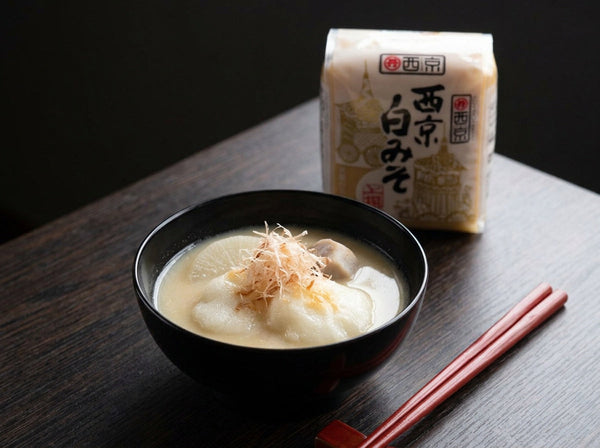
Mochi (餅) is Japan's rice cake: glutinous rice, steamed and pounded until smooth and stretchy. It is eaten at festivals all year, but above all at New Year, in a bowl of ozōni soup and as the stacked kagami mochi offering.
This guide covers what mochi is, the New Year customs, how ozōni changes from region to region, and how to make a bowl at home. It sits inside our Culture Masterclass.

For Kyoto's white miso ozōni: Classic Saikyo Miso, 500g, Kyoto's sweet white miso.
What Is Mochi Made Of?
Mochi is made from mochigome, glutinous rice. Japan's Ministry of Agriculture (MAFF) explains the difference: the starch in mochigome is almost 100% amylopectin, the part that makes rice sticky, while everyday rice (uruchi) has both amylopectin and amylose, so it cooks to a firmer grain. Traditionally the steamed rice is pounded with a wooden mallet (kine) in a mortar (usu), and pounding mochi at the end of the year was once common at home.
MAFF links Japan's mochi culture to the late Yayoi period, when steaming vessels and round-ended pestles appear, and mochi is recorded in the Nara-period fudoki gazetteers.
Source: MAFF aff magazine December 2017 and January 2020 mochi features. Facts extracted and reworded.
Round Mochi or Square Mochi?
Japan splits roughly at Sekigahara in Gifu. East of it, square mochi (kakumochi) is usual; west of it, round mochi (marumochi). Round is the older shape. Square mochi came in the Edo period, when mochi was rolled into flat slabs and cut, and it spread from Edo because it travelled well. There are exceptions on both sides, and some places along the line use both.
Source: MAFF aff magazine December 2017 and January 2020 mochi features. Facts extracted and reworded.
What Is Kagami Mochi?

Kagami mochi (鏡餅), mirror mochi, is two flat round mochi stacked as a New Year offering to the New Year god, said to imitate a sacred mirror. A daidai orange goes on top, a pun on "generation after generation", with fern leaves for long life. On 11 January it is broken open in kagami-biraki and eaten, often in sweet red bean soup. It is broken with a wooden mallet, never cut with a knife, because pointing a blade at an offering is bad luck.
Source: MAFF Let's! Washoku Project kagami mochi page. Facts extracted and reworded.
What Is Ozōni?
Ozōni (お雑煮) is the soup with mochi at the heart of New Year food, eaten on the first days of the year. MAFF records that it began as a celebration dish for samurai and nobles in the Muromachi period and became a New Year dish for everyone in the Edo period. Every region, and nearly every family, makes it differently.
- Tokyo. Grilled mochi with chicken, greens, kamaboko and mitsuba under a clear dashi seasoned with light soy sauce, finished with yuzu peel.
- Kyoto. Round mochi in a white miso broth with kashira-imo (taro) and daikon, topped with fine bonito threads. Round mochi stands for harmony and long life, taro for descendants, and daikon cut in rounds for harmony.
- Kagawa. Anmochi zōni: round mochi filled with sweet bean paste, in white miso with niboshi stock, daikon, red Kintoki carrot and tofu. Sugar was once precious, and families are said to have put it in their New Year soup once a year.
- Shimane. Round mochi in a clear soy-seasoned broth, often of ago (flying fish) stock, topped simply with iwa-nori seaweed and bonito flakes.
- Hakata, Fukuoka. Buri (yellowtail) for promotion, because the fish changes name as it grows, with katsuo-na greens and a grilled flying fish stock. The local cooks say ozōni is only as good as its dashi.
Source: MAFF Uchi no Kyōdo Ryōri pages for Tokyo, Kyoto, Kagawa, Shimane and Hakata ozōni; MAFF aff magazine December 2017 and January 2020 mochi features. Facts extracted and reworded.
How to Make Tokyo-Style Ozōni at Home
- Make a dashi: put kombu in cold water and take it out just before the boil, add bonito flakes for a minute, then strain.
- Season the dashi with a little light soy sauce and salt, or dilute Kōmi Shiro Dashi to taste for a quick clear broth.
- Toast the mochi until lightly browned and soft. Simmer greens such as komatsuna in the broth for two minutes.
- Put the mochi, cooked chicken, kamaboko and greens in a bowl, pour over the hot broth, and finish with yuzu peel.
For Kyoto style, dissolve white miso into kombu dashi over a low heat instead, and add boiled taro and daikon.
Eat Mochi Safely
MAFF warns that choking on mochi causes accidents every year. Cut it into small pieces, chew slowly and well, and take extra care with young children and older people.
Source: MAFF aff magazine December 2017 and January 2020 mochi features. Facts extracted and reworded.
How to Store Mochi
MAFF's guidance: mochi left out grows mould in about a week. Kept in the fridge it lasts a few days, or one to two weeks wrapped tightly in film. For longer, brush off the flour, wrap each piece and freeze it for two to three months.
Source: MAFF aff magazine December 2017 and January 2020 mochi features. Facts extracted and reworded.
Popular Products
We do not sell mochi itself. These are the broth makers.


Frequently Asked Questions
What is mochi made from?
Glutinous rice (mochigome), steamed and pounded.
What is ozōni?
Japan's New Year soup with mochi; clear in Tokyo, white miso in Kyoto.
When is kagami mochi eaten?
At kagami-biraki on 11 January, broken with a mallet rather than cut.
Why is mochi round in some places and square in others?
Round is the old shape, kept in the west; square, cut from flat slabs, spread from Edo in the east.
How long does mochi keep?
About a week before mould at room temperature; two to three months frozen.
Where to Buy Ozōni Ingredients in the UK
We do not sell mochi itself, but we stock the broth makers: white miso, Kōmi Shiro Dashi, kombu and bonito flakes. Shop Miso · Shop Kombu.
For more, browse the Culture Masterclass. Read next: Toshikoshi soba for New Year's Eve · Udon guide
Sources: Ministry of Agriculture, Forestry and Fisheries of Japan: Uchi no Kyōdo Ryōri pages for Tokyo, Kyoto, Kagawa, Shimane and Hakata ozōni; aff magazine December 2017 and January 2020 mochi features; Let's! Washoku Project kagami mochi page; retrieved 5 November 2026. Facts extracted and reworded, not reproduced.

