Japanese Curry Rice: History, Ingredients and How to Make It
Japanese curry, karē raisu (カレーライス), is one of Japan's everyday comfort foods: a thick, gently spiced sauce with meat, potato, carrot and onion, served over rice. It is milder and thicker than most Indian curries, and in the UK many people know it from katsu curry.
This guide covers where Japanese curry came from, what goes in it, and how to make it at home. It sits inside our Pantry Masterclass.

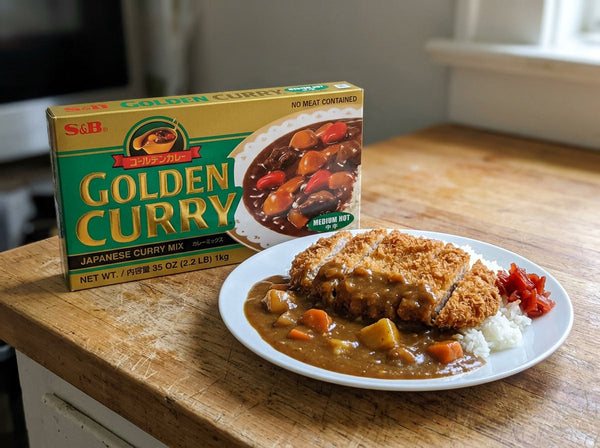
Our curry roux: S&B Golden Curry Medium Hot, 1kg, and S&B Japanese Curry Powder, 85g for making your own roux.
How Curry Came to Japan
Curry reached Japan by way of Britain. In a MAFF interview, Kōsuke Nakajima of the All Japan Curry Industry Cooperative explains that in India these dishes are not called "curry" at all. The British, trading with India from around the 18th century, took the dishes home and created ready-mixed curry powder, and that powder arrived in Japan early in the Meiji era.
At first it was an expensive dish served in Western-style restaurants. Over about 50 years, Japanese cooks thickened it with flour and fat so that it suited Japanese rice, and school meals and the military spread it across the country. Japanese companies then began making curry powder, curry roux and ready-to-heat pouches. MAFF's rice pages count curry rice, with tonkatsu and croquettes, as one of the three great yōshoku: Western dishes reworked to eat with rice in the late Meiji and Taishō eras, now so settled in Japan that few people think of them as foreign.
Source: MAFF NIPPON FOOD SHIFT curry interview; MAFF OKOME-SUMMARY page on washoku and rice. Facts extracted and reworded.
Yokosuka Navy Curry

One theory traces curry rice to the Japanese Navy. MAFF's regional cuisine page for Kanagawa records that in the Meiji era the navy adopted the British Navy's curry-flavoured stew and thickened it, probably to suit rice and so it would not spill on a rolling ship, and that sailors leaving the navy are said to have taken it home across Japan.
The port city of Yokosuka recreated the recipe in 1999 to promote the town. Yokosuka Kaigun Curry is a registered name, and approved shops serve it in the navy way: curry rice with a salad and a glass of milk.
Source: MAFF Uchi no Kyōdo Ryōri page for Yokosuka Kaigun Curry. Facts extracted and reworded.
What Is in Japanese Curry?
There is no fixed list. Nakajima points out that potato, carrot and onion became the usual vegetables because they grow well and cheaply in Japan. MAFF's Yokosuka recipe uses beef or chicken with potato, carrot and onion, cooked with curry powder and flour, butter, stock, tomato and a little ketchup and Worcester sauce.
The quick way is a curry roux: a block of spices already cooked with fat and flour, which melts into the stock and thickens it in one step. S&B launched Golden Curry in 1966. Curry powder is the spice blend on its own; cook it into butter and flour and you have made the roux yourself.
Source: MAFF NIPPON FOOD SHIFT curry interview; MAFF Yokosuka Kaigun Curry recipe; product specifications. Facts extracted and reworded.
How to Make Japanese Curry with a Roux
- Brown sliced onion, then your meat, in a little oil.
- Add chunks of carrot and potato, cover with water or stock, and simmer until tender.
- Take the pan off the heat, break in the roux and stir until it has melted. Taking it off the heat first stops lumps forming.
- Return to a gentle simmer for a few minutes, stirring, until thick and glossy. Follow the roux-to-liquid ratio on the pack.
- Serve over hot Japanese rice. For katsu curry, top with a sliced breaded pork or chicken cutlet.
Full recipes: How to make katsu curry · Japanese curry sauce from scratch
Fukujinzuke: Curry's Pickle
In Japan curry often comes with fukujinzuke (福神漬け), a soy sauce pickle of daikon, aubergine, lotus root and other vegetables. MAFF's traditional foods page records that it was developed in Tokyo in the Meiji era by the shop Shuetsu in Ueno, and named after the Seven Lucky Gods.
How it became curry's partner is not certain: one story credits first class on NYK Line ships to Europe, serving it in place of chutney, another the Imperial Hotel.
Source: MAFF Nippon Dentōshoku Zukan page for fukujinzuke. Facts extracted and reworded.
Popular Products
Four to start with: the roux, the powder, the rice to serve it on, and the panko for a katsu cutlet.

S&B Golden Curry Medium Hot, 1kg
The roux block in the catering box, for katsu curry and curry rice at volume. Medium hot (chūkara) sits above mild.


Frequently Asked Questions
What is the difference between Japanese and Indian curry?
Japanese curry is thickened with flour and fat into a smooth, glossy sauce, milder and slightly sweet, and served over rice.
Is katsu curry the same as tonkatsu sauce?
No. Katsu curry is a breaded cutlet served with curry; tonkatsu sauce is a thick fruity brown sauce served with the cutlet on its own.
What is the difference between curry roux and curry powder?
Roux is spice already cooked with fat and flour, so it thickens the sauce; powder is the spice alone.
Does Japanese curry contain wheat?
Usually, because the sauce is thickened with flour. Check the pack.
How much curry do Japanese people eat?
The All Japan Curry Industry Cooperative puts it at about 79 curry meals per person a year, from 2016 figures, and it marks 22 January as Curry Day.
Where to Buy Japanese Curry in the UK
We stock S&B Golden Curry roux and Japanese curry powder, with the rice and panko to go with them, and deliver across the UK.
For more, browse the Pantry Masterclass, or read Tonkatsu sauce explained and our Udon guide.
Sources: Ministry of Agriculture, Forestry and Fisheries of Japan: Uchi no Kyōdo Ryōri page for Yokosuka Kaigun Curry; NIPPON FOOD SHIFT curry interview; OKOME-SUMMARY page on washoku and rice; Nippon Dentōshoku Zukan page for fukujinzuke; retrieved 5 November 2026; product specifications. Facts extracted and reworded, not reproduced.

