
Wasabi Paste, Powder or Fresh: What Is in the Tube?
Most wasabi outside Japan is not mostly wasabi. Read the back of a tube and you will usually find horseradish first, with a small share of real wasabi further down.
This guide explains what real wasabi is, what goes into tubes and powders, and when it is worth grating fresh. It sits inside our Pantry Masterclass.

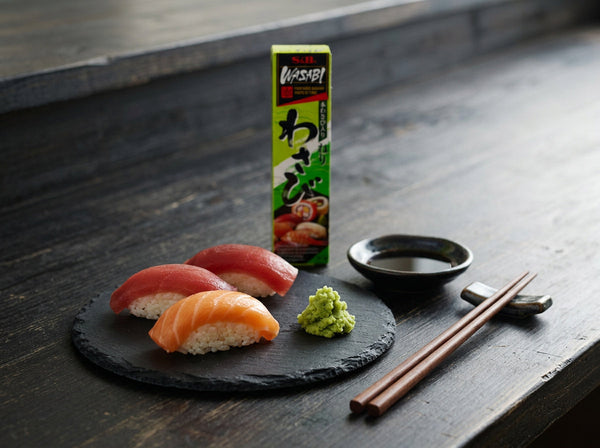
Our everyday wasabi: S&B Wasabi Paste, 43g.
What Is Real Wasabi?
Wasabi (山葵) is a plant native to Japan, growing wild across the country. The part you grate is the rhizome, the thick stem at the base. Japan's Ministry of Agriculture (MAFF) describes the flavour of freshly grated wasabi as a sweet, clean heat, and it is the classic partner for sushi, sashimi and soba.
It is hard to grow. Water wasabi needs large amounts of clean spring water at a steady temperature all year round. MAFF records that cultivation began about 400 years ago, in the early Edo period, at Utōgi in Shizuoka, when wild plants were moved to a spring. Shizuoka's terraced wasabi fields, fed by spring water and shaded by alder trees, were named a Globally Important Agricultural Heritage System in 2018. Japan grew 1,476 tonnes in 2025, mostly in Nagano, Shizuoka and Iwate.
Source: MAFF Shizuoka wasabi GIAHS page; aff magazine December 2020 wasabi feature; Forestry Agency special forest products statistics. Facts extracted and reworded.
What Is in a Wasabi Tube?
Because real wasabi is scarce and costly, most tubes and powders are based on horseradish, with mustard for extra heat, colouring for the green, and some real wasabi for flavour. Our S&B tube lists its recipe on the pack:
- Horseradish: 31.7%
- Wasabi: 4.5%
- Also: sorbitol, rice bran oil, salt, dextrin, potato starch, water and flavouring. Contains mustard.
The Japanese label reads 本わさび入り, "contains real wasabi", which is accurate: it does, in a small share. That is normal for everyday wasabi, and it is why tube wasabi is sharp and nose-clearing rather than sweet.
Source: S&B import specification. Facts extracted and reworded.
Paste, Powder or Fresh?
- Paste (tube). Ready to use, consistent, keeps in the fridge once opened. Best for everyday sushi, dressings and dips.
- Powder. Mixed with cold water just before service, so kitchens make only what they need. Check the pack to see how much real wasabi it contains.
- Fresh root. The real thing: grated to order, sweet as well as hot. Its heat is volatile, so grate it just before eating. Best when the fish is the star.
How to Grate Fresh Wasabi

Grate the rhizome on a fine grater just before you eat. Sushi chefs use a sharkskin grater (samegawa oroshi), whose fine texture suits wasabi perfectly, and a small brush to gather it.
MAFF's guidance for keeping fresh wasabi: wash it, dry it, wrap it and keep it in the vegetable drawer, where it lasts a month to six weeks; grated wasabi can be frozen. The leaves, stems and flowers are edible too: in Shizuoka the chopped stems and leaves are pickled in sake lees as wasabi-zuke.
Source: MAFF aff magazine December 2020 wasabi feature; Uchi no Kyōdo Ryōri wasabi-zuke page. Facts extracted and reworded.
Popular Products


Frequently Asked Questions
Is the wasabi in a tube real wasabi?
Usually only partly. Our S&B tube is 31.7% horseradish and 4.5% wasabi.
What does real wasabi taste like?
Sweeter and cleaner than tube wasabi, with a heat that does not last long once grated.
Where does wasabi grow?
In cold, clean spring water, mainly in Nagano, Shizuoka and Iwate.
Does wasabi paste contain mustard?
Many do. Our S&B tube contains mustard, so check the pack if you have an allergy.
How do you keep fresh wasabi?
Washed, dried and wrapped in the vegetable drawer for a month to six weeks.
Where to Buy Wasabi in the UK
We stock S&B Wasabi Paste and graters for fresh wasabi, with the rest of our Japanese spices and seasonings, and deliver across the UK.
For more, browse the Pantry Masterclass, or read Wasabi and our Soba guide.
Sources: Ministry of Agriculture, Forestry and Fisheries of Japan: Shizuoka wasabi GIAHS page; aff magazine December 2020 wasabi feature; Uchi no Kyōdo Ryōri wasabi-zuke page; Forestry Agency special forest products statistics; retrieved 5 November 2026; S&B import specification. Facts extracted and reworded, not reproduced.

