
Udon Noodles: Sanuki, Kitsune, Kishimen and More
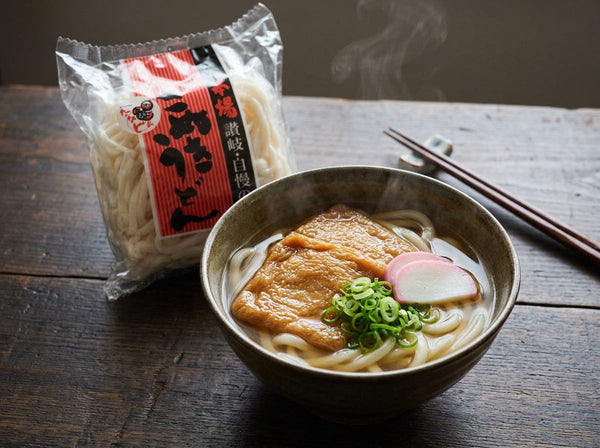
Udon (うどん) is Japan's thick wheat noodle: wheat flour, salt and water, kneaded, rested, rolled and cut. Soft or springy, served hot in dashi or cold for dipping, it is everyday food across Japan.
This guide covers where udon comes from, the regional styles worth knowing, the New Year bowl, and how to serve it at home. It sits inside our Pantry Masterclass.

Our udon: Miyatake Sanuki Udon, 5 x 180g, fully cooked udon from Kagawa, ready in under two minutes.
Where Does Udon Come From?
Kagawa, the old province of Sanuki on Shikoku, is Japan's udon heartland. Japan's Ministry of Agriculture (MAFF) explains why: little rain made rice hard to grow, while the mild winters suited wheat. The shallow coasts made salt, the Seto Inland Sea gave anchovies for iriko (dried sardine) stock, and Shōdoshima island brewed soy sauce. Everything a bowl of udon needs was close at hand. An Edo-period festival screen of the Kompira shrine already shows an udon shop.
A well-known legend says the monk Kūkai brought udon back from China. MAFF reports it as a story that is told, not as fact. Wheat was grown in Kagawa as a second crop after rice, and handmade udon was food for special days: New Year, festivals and guests.
Source: MAFF Uchi no Kyōdo Ryōri (regional cuisine) page for Kagawa. Facts extracted and reworded.
Japan's Regional Udon Styles
- Sanuki udon, Kagawa. Thick, firm and smooth, known for its strong bite, usually in an iriko dashi.
- Kitsune udon, Osaka. Udon in a dashi of ma kombu and mixed fish flakes, topped with sweet-savoury simmered aburaage (fried tofu). Osaka udon is softer and not too thick, so it takes up the dashi. The story goes that it began in 1893 at Matsubaya, an udon shop in Senba, when a customer put the side dish of aburaage on top of plain udon.
- Kishimen, Aichi. Flat udon about 1mm thick and 7 to 8mm wide. Because flat noodles taste lighter in the mouth, the broth is made strong, traditionally with muroaji (a kind of scad) and tamari, which is brewed almost entirely from soya. In summer it is also eaten cold, as koro.
- Gunma udon. Gunma has three styles: Kiryū's himokawa, so wide that some shops cut it over 10cm across; Tatebayashi udon, made with the local Hyakunen Komugi wheat and known for kama-tama (hot udon with raw egg); and Mizusawa udon, said to be one of Japan's three great udon, with Akita's Inaniwa and Kagawa's Sanuki, usually served cold on a bamboo zaru.
Source: MAFF Uchi no Kyōdo Ryōri (regional cuisine) pages for Kagawa, kitsune udon, kishimen and Gunma udon. Facts extracted and reworded.
Shippoku Udon: Kagawa's Winter Bowl

In Kagawa, shippoku udon is daikon, carrot, aburaage and tofu simmered together in iriko stock, then poured over hot udon: a one-bowl winter meal. Spring onion and grated ginger go on top. Some families make it with bonito or kombu dashi instead, and add chicken or pork for richness. It is sometimes eaten at the end of the year in place of toshikoshi soba.
Source: MAFF Uchi no Kyōdo Ryōri (regional cuisine) page for shippoku udon. Facts extracted and reworded.
What Is Toshiake Udon?
Toshiake udon (年明けうどん), New Year udon, is a newer custom started by Kagawa's Sanuki udon promotion council. White udon is topped with something red, such as kamaboko, prawns, umeboshi or carrot, for a red and white bowl, and eaten by 15 January to wish for a happy year. Udon has long been eaten as a lucky food because it is thick and long.
Source: MAFF Uchi no Kyōdo Ryōri (regional cuisine) page for toshiake udon. Facts extracted and reworded.
How to Make an Udon Broth at Home
A classic Kagawa broth is iriko simmered just below the boil, then bonito flakes, strained and seasoned with light soy sauce. For a quicker bowl, dilute a dashi concentrate with hot water, then taste and adjust.
- Heat cooked udon in boiling water or straight in the broth: under two minutes for Miyatake. Dried udon needs longer; Toa Maru Udon takes about ten minutes.
- Make the broth. Kōmi Shiro Dashi gives a pale, clear broth that suits Sanuki and Osaka styles. For kishimen's darker, stronger broth, season dashi with tamari.
- Put the udon in a warmed bowl, pour over the broth and add the toppings: aburaage for kitsune, tempura, spring onion, or a raw egg for kama-tama.
Source: MAFF Uchi no Kyōdo Ryōri (regional cuisine) page for Kagawa; product specifications. Facts extracted and reworded.
Popular Products
The noodles, the dashi and the seasonings for a bowl of udon at home.

Miyatake Sanuki Udon, 5 x 180g
Fully cooked udon from Kagawa, sealed in five packs: drop into hot broth and it is ready in under two minutes.

Aoi Dried Udon, 1kg
Made with a high-hydration, slowly aged dough for a texture closer to fresh udon.

Toa Maru Udon, 200g
Thick, round dried udon from Banshu in Hyōgo, kneaded with cold water; about ten minutes to cook.

Kōmi Shiro Dashi Concentrate, 1L
Our own white dashi: skipjack, mackerel and bullet tuna dashi with kombu, seasoned with soy sauce. Dilute it for a clear udon broth in seconds.


Frequently Asked Questions
What is udon made from?
Wheat flour, salt and water. Because it is wheat, udon is not gluten free.
What is the difference between udon and soba?
Udon is a thick wheat noodle; soba is a thinner buckwheat noodle. Japan's old saying puts it as udon in the west, soba in the east. See our soba guide.
What is kitsune udon?
Udon in dashi topped with sweet simmered aburaage. Kitsune means fox.
What is kishimen?
Flat udon from Aichi, about 1mm thick and 7 to 8mm wide, served in a strong broth.
How long does udon take to cook?
Cooked udon such as Miyatake needs under two minutes; thick dried udon about ten.
Where to Buy Udon in the UK
We stock Miyatake Sanuki udon, dried udon from Aoi and Toa, and the dashi, tamari and kombu for the broth.
For more, browse the Pantry Masterclass. Read next: Japanese noodles explained · Katsu udon recipe
Sources: Ministry of Agriculture, Forestry and Fisheries of Japan, Uchi no Kyōdo Ryōri (regional cuisine) pages for Kagawa, toshiake udon, shippoku udon, kishimen, Gunma udon and kitsune udon, retrieved 5 November 2026; product specifications. Facts extracted and reworded, not reproduced.

